

Skip to content
Methodology and science

What is not measured in a structured way remains a guess.

Every hire is a prediction. Traitwise makes measurable the three questions that most strongly decide occupational success, and reads the answers in the context of the specific role.

Cognitive
ability
Intrinsic
motivation
Personality

Three perspectives. Three measurements.

Each of the three measurements rests on established psychological models. Times per part are guides; the full assessment takes around 30 minutes at the median.

Measure 1

Cognitive ability

42 tasks · about 18 minutes

Captures how quickly someone understands new information, sees connections and solves unfamiliar problems. The best-researched predictor of job performance.

Scientific details
What does Traitwise measure here?
The person works through tasks in logical, verbal, numerical and figural domains. What counts is whether they find the correct solution.
Why does this matter at work?
Cognitive ability is a well-evidenced predictor of job performance across occupations and industries. It helps you assess how well someone processes new information, learns and solves unfamiliar problems.
Can someone cheat?
Several safeguards (including a time limit per task and full-screen mode) make unauthorised help harder. For extra security we offer a supervised session by video — configurable in Traitwise, or on request.
Are there shorter versions?
Yes. Besides the standard version with 42 tasks, we offer a short version with 20 and a rapid test with 10. Which one fits depends on the role and your selection process.

Measure 2

Intrinsic motivation

60 statements · about 5 minutes

Makes visible which activities and working environments appeal to someone from within, and how well that interest profile fits the role. People who draw energy from the work itself stay longer and more engaged.

Scientific details
What does Traitwise measure here?
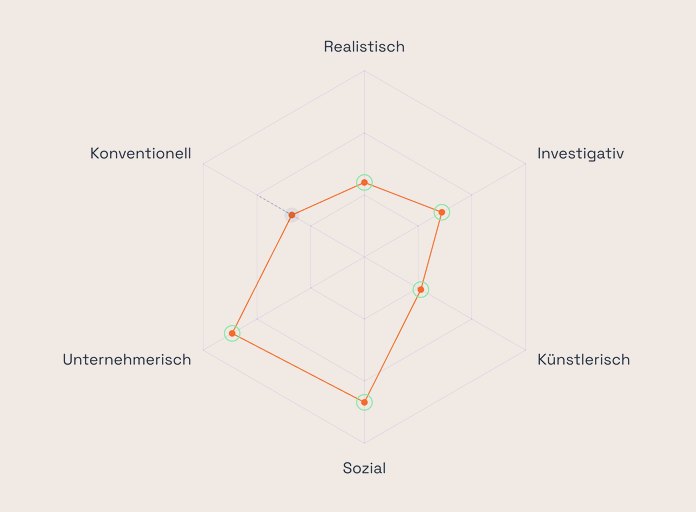
We capture occupational interests with John L. Holland’s RIASEC model. The model has been studied for decades and is used internationally, including in career guidance by the US Department of Labor.
Why does this matter at work?
Fit between occupational interests and the work itself is linked to higher satisfaction, better performance and lower turnover. It helps you assess whether someone is likely to stay interested in the tasks of the role.
Is there good or bad motivation?
There is no generally good or bad interest profile. What energises one person may leave another cold. What matters is whether personal preferences fit the daily work.
How is it scored?
We compare the personal interest profile with the occupation profile from O*NET, the US Department of Labor’s occupational database. The calculated match, also called congruence, shows interest fit with the stored occupation profile.

Measure 3

Personality

93 statements · about 11 minutes

Six dimensions, 20 facets: how someone approaches tasks, works with others, handles pressure, and whether they attribute results to their own actions or to circumstances. No types, no colours.

Scientific details
How is this different from a type test?
Traitwise does not assign colours or types. We measure individual personality traits and their levels. Procedures such as MBTI and Everything DiSC are not intended for personnel selection. The organisations behind them say so themselves.
Is there an ideal personality?
No. What matters is how personality fits the job’s requirements, the team and the organisation. That is why we tell candidates: the point is to get to know you as you actually are. Honest answers help both sides see whether working together fits.
Why does this matter at work?
Personality influences how someone works, handles pressure and collaborates. Traitwise shows which traits and facets a person brings. You can then assess how well their working style fits the specific requirements of the role.
Why does Traitwise follow HEXACO?
HEXACO describes personality in a differentiated way, down to individual facets. Traitwise follows five dimensions with 20 facets in total and adds locus of control. That describes how strongly someone attributes results to their own actions or to external circumstances.

Each measurement stands on its own at first. Only together, and compared with the requirements of your role, do they become a meaningful complete picture.

How the complete picture is built.

A · Role profile

What level of problem solving does the role need, which activities must someone enjoy, which behaviours does the day-to-day work carry? The better the job description and requirements, the better the measurement.

B · Candidate profile

Percentiles for problem solving and personality, congruence for interests. They are not altered, only set in relation.

The complete picture in practice

Each candidate profile is laid over the role profile: the dashed outline is the role, the coloured area the person. Where they overlap, the person can carry the work. Where they diverge, there is a point you should explore. No score, no formula: the finding is in the picture.

405530807065 Realistic Investigative Artistic Social Enterprising Conventional
Overlap with the role Over- or under-coverage versus the role

Role and candidates compared

Interest directionRoleLauraTobias
Realistic404072
Investigative554885
Artistic303568
Social807828
Enterprising708230
Conventional654522

The finding

  • OverlapEnterprising 82 · Social 78

    On or above the role. Leadership and working with people carry the fit — that is exactly where this candidate draws energy.

  • Under-coverageConventional 45 versus 65

    Routine and rule-based work appeals to her less than the role requires. The check for the conversation: who carries the routine in the team? Not a reason to exclude her.

  • Over-coveragenot the case here

    If the blue area sat far outside the dashed outline, that would not be a bonus: someone who clearly overshoots a role is more quickly under-challenged. Under-challenge is a turnover risk.

The same role, a different candidate: the blue area sits almost as a mirror image of the dashed outline. What the role needs does not attract him; what drives him barely appears in the role. That is no longer a single check — it is a pattern. The report says so just as clearly.

  • Overlapnone

    No interest direction carries the fit. Where the first example had a check for the conversation, here there is a clear picture.

  • Under-coverageSocial 28 versus 80 · Enterprising 30 versus 70 · Conventional 22 versus 65

    Contact, leadership and rule-based work are the core of team leadership. Those three directions give him no energy: three under-coverages in the three carrying dimensions.

  • Over-coverageInvestigative 85 versus 55 · Realistic 72 versus 40 · Artistic 68 versus 30

    Analysis, technical work and design are his drivers. In team leadership they sit unused: under-challenge from day one, and therefore a turnover risk.

Explained scientifically: role profile, engine, and why there is no single scoreHow the role profile is built, what the software may and may not do, and how fit is measured.

Why no score with fixed weights?

A classic score is a linear combination of a few measurements with fixed weights. It is compensatory — a weaker signal is offset by a stronger one — and it treats every role the same. For a role where conscientiousness is everything, and another where openness and social skill count, the same formula does not produce a useful statement. Traitwise therefore lays the complete profile, all dimensions and facets, against the specific role profile; fit and ranking are the result of that comparison. Which dimension counts how strongly is decided by the role, not by a formula.

What may the engine do, and what not?

The scoring logic is a trade secret. Its limits are not:

InputOnly the scored results plus the role profile. No CV, no photo, no free text.
LimitsNo statement without a measurement. No diagnosis. No final hiring decision.
TraceableEvery statement in the report can be traced back to visible individual scores.

A general language model can explain psychological literature. Traitwise works inside a defined diagnostic system: standardised measurement data, specified constructs, role requirements and a structured synthesis. The assessment sets the frame in which the software may interpret.

How is the role profile built?

A job description says what someone should do. The role profile says which psychological prerequisites they need for it: the cognitive demand, the interest profile of the work, and the behaviours the day-to-day role carries. It is built in a guided, structured process with the client: understand the role, specify requirements, set the profile, use it for comparison and ranking. The interest profile of a role comes from O*NET, the US Department of Labor’s occupational database with standardised profiles for more than 900 occupations; for the European context, occupations are mapped via the EU classification ESCO where needed.

For context: every measurement has error. Traitwise therefore reads scores as ranges, not points, and never treats a single score as a reason to exclude someone.

Why the complete picture predicts performance.

What CVs and interviews show is only weakly related to later performance. The traits Traitwise measures relate to it more strongly. The strongest single method remains the structured interview, and Traitwise does not replace it — it makes it better.

What counts in a typical hiring process.

  • Years of work experience.07
  • Unstructured interview.19

Traitwise measurement

  • Cognitive ability.31
  • Conscientiousness.19
  • Occupational interests.24
  • Locus of control.22

Structured interview with Traitwise

  • The strongest single predictor. Traitwise builds it from the profile: the profile-based interview (section 02)..42

Traitwise overall model

Only the combination of measured scores produces a coherent overall model as a prediction or estimate.≈.60

Estimate

The overall value is derived from meta-analytic evidence and models of multi-predictor selection systems (Sackett et al., 2022; Dahlke & Sackett, 2022), not from a Traitwise validation study. It describes a relationship at group level, not an individual probability of success, and is not a decision rule at Traitwise. A criterion validation with performance data from client projects is under way; the results are intended for publication.

Explained scientifically: r, r² and why the numbers have got smallerWhat validity coefficients mean, and why Traitwise works with the current, lower values.

What r means, and what it does not

r describes how closely a trait is statistically related to later performance, measured across many people. r = .31 does not mean that 31 percent of predictions are correct, and it says nothing about an individual. It means: in large groups, selecting on this trait produces better decisions on average than ignoring it.

What r² means

r² translates the relationship into explained variance. An unstructured interview with r = .19 explains about 3.6 percent of performance differences, cognitive ability about 10 percent, the structured interview about 18 percent. The rest remains open. That is why good assessment combines several predictors.

Why the numbers have got smaller

In 1998 Schmidt and Hunter published the most influential meta-analysis on the predictive power of selection methods. In 2022 Sackett, Zhang, Berry and Lievens corrected a systematic overcorrection in the old estimates. Many values fell. Traitwise works with the current values.

Method19982022
Intelligence test.51.31
Work sample.54.33
Structured interview.51.42
Integrity test.41.31
Unstructured interview.38.19
Work experience.18.07
Interest inventory.10.24

Schmidt & Hunter (1998); Sackett et al. (2022).

What this means in practice

The ranking has barely changed, nor has the core point: selection methods differ considerably in how much they say about later performance. CVs and years of experience sit far back. Cognitive ability, interests and conscientiousness sit at the front and are hard to observe in conversation. Those are exactly what Traitwise measures. The structured interview remains the strongest single building block. Traitwise supplies the guide for it, tailored to the person’s profile.

What does the result look like?

The methodology explains the measurement. The sample report shows what comes of it.

Thirteen pages, explained chapter by chapter: executive summary, cognitive profile, interest fit, personality signature, facets, appendix.